The Story of Miyabi Knives: Japanese Craftsmanship from Seki
Knife Education

The Story of Miyabi Knives: Japanese Craftsmanship from Seki

Written by

Adam Dodd

Adam Dodd is the founder of Chef Supply Co, a Sydney-based kitchen knife and culinary essentials brand founded in 2017. With a focus on quality, craftsmanship and real-world performance, Adam and the Chef Supply Co team put products through rigorous testing before bringing them to customers. His work covers Japanese and professional kitchen knives, blade construction, steel types, knife profiles and the practical details that help cooks choose and care for the right knife.

There are Japanese knives that look beautiful. There are Japanese knives that perform exceptionally well. Then there are knives that bring both together with a level of detail that makes you stop and look at the blade before you even start cooking.

Miyabi knives are made for that third category.

Handcrafted in Seki, Japan, Miyabi combines traditional Japanese knife-making techniques with modern steel technology to create knives that are as much about precision as they are about craftsmanship.

But what actually makes a Miyabi knife different?

To understand that, you need to look beyond the Damascus pattern and the polished handles. The story starts in Seki — one of Japan's most important blade-making centres — and continues through the steel, geometry, sharpening and finishing that go into each knife.

A closer look at the Miyabi presentation and packaging.

Why Seki, Japan Matters

Miyabi knives are handcrafted in Seki, Japan, a city with centuries of blade-making history.

Seki's reputation was built around swordmaking, and over generations that knowledge evolved into the production of kitchen knives and other precision blades.[source]

That history matters because Japanese knife-making is not simply about producing a sharp piece of steel. It is about understanding how steel behaves, how a blade should be shaped, how it should be sharpened and how all of those details affect the way a knife performs in the kitchen.

Miyabi brings that traditional Japanese approach into a modern production environment, combining Japanese craftsmanship with advanced materials and engineering.

miyabi-knife-seki-japan-craftsmanship.jpg
Japanese craftsmanship is at the heart of the Miyabi range.

What Is Miyabi?

MIYABI is a Japanese knife brand based in Seki, Japan, that became part of the ZWILLING Group in 2004. ZWILLING is a German company with roots in Solingen, Germany, while MIYABI's knives continue to be made in Seki, one of Japan's historic centres of blade making.

The 2004 acquisition brought MIYABI into the ZWILLING Group, but the knives remain rooted in Japanese manufacturing and craftsmanship. Today, MIYABI combines Japanese knife-making traditions with modern technology and engineering developed within the ZWILLING Group.

That distinction matters.

MIYABI isn't simply a German knife brand making Japanese-style knives. Its production is based in Seki, Japan, where the brand draws on the region's long history of blade making. At the same time, being part of the ZWILLING Group gives MIYABI access to modern manufacturing technology, steel development and engineering expertise.

The result is a knife that sits between two traditions: Japanese blade-making craftsmanship and European engineering.

You see that combination in the details — thin Japanese blade profiles, carefully selected steels, precision heat treatment, multi-layered blade construction and hand-finishing processes such as Honbazuke.

And while the Damascus patterns and premium handles are visually striking, they are only part of what makes a MIYABI knife different.

Source: ZWILLING — Our History

How Miyabi Knives Are Made

A Miyabi knife isn't simply stamped out, sharpened and boxed.

Depending on the collection, the manufacturing process involves more than 100 individual production steps.[source] Each stage contributes to the final balance between sharpness, durability, appearance and handling.

The process can involve shaping the blade, heat treating the steel, creating the layered construction, grinding and polishing the blade, applying the edge and finishing the handle.

That attention to detail is particularly noticeable when you look closely at the blade.

Close-up of a Miyabi Damascus blade showing the layered steel construction
The blade details, finish and construction are easier to appreciate up close.

Thin Japanese Blade Geometry

One of the biggest differences you'll notice with a Japanese-style chef's knife is the blade geometry.

Rather than relying on a thick, heavy blade to do the work, Japanese knives are often designed around a thinner cutting profile.

The result is a knife that can move through ingredients with less resistance and greater precision.

This is particularly useful for slicing vegetables, preparing proteins and making controlled cuts where accuracy matters.

The trade-off is that thinner, harder blades generally demand more care. A Miyabi isn't a knife you should treat like a cleaver or use to hack through bones.

Macro shot of a Miyabi knife edge
A closer look at the refined edge of a Miyabi blade.

Advanced Steel Technology

Steel is one of the biggest factors separating one Miyabi collection from another.

Different Miyabi ranges use different steels, each chosen to deliver a particular combination of hardness, edge retention and cutting performance.

Two collections that demonstrate this particularly well are the 5000FCD and 5000MCD Birchwood.

What Does Damascus Steel Actually Mean?

Damascus is one of the most recognisable features of premium Japanese knives, but the term is often misunderstood.

The flowing pattern visible on the blade comes from layered steel construction. Different layers of steel are forged or bonded together and then finished in a way that reveals the contrasting structure.

But the Damascus pattern isn't what makes a knife sharp.

The steel used for the core, the heat treatment, blade geometry and final edge are far more important to performance.

In other words, don't buy a knife simply because the Damascus pattern looks impressive. Look at what is underneath it.

Flowing Damascus steel pattern on a Miyabi chef's knife blade
The Damascus pattern is created by the layered blade construction.

What Is Honbazuke Sharpening?

Honbazuke is a traditional Japanese three-step sharpening and polishing process used to create a refined knife edge.[source]

Rather than simply sharpening the blade on a machine and sending it out, the edge is carefully refined through multiple stages: a coarse grind on a vertically rotating whetstone, a fine hone on a horizontal wheel, then a final strop on leather.

This contributes to the exceptionally sharp cutting feel that Japanese knives are known for.

It's also one of the reasons a premium Japanese knife can feel noticeably different the first time you use it.

Miyabi 5000FCD vs 5000MCD Birchwood

If you're comparing Miyabi knives, the 5000FCD and 5000MCD Birchwood are two collections worth looking at closely.

They share the same Japanese craftsmanship philosophy, but they are aimed at slightly different preferences.

Miyabi 5000FCD

The 5000FCD uses an FC61 core surrounded by 48 layers of steel, creating a 49-layer blade construction with its distinctive Damascus appearance.

The blade is hardened to approximately 60–62 HRC and finished with a Honbazuke edge.

It is a strong choice for cooks who want premium Japanese performance without moving all the way into the extremely hard territory of some of Miyabi's highest-end steels.

Miyabi 5000FCD Gyuto chef's knife, 16cm, with 49-layer Damascus blade

Miyabi 5000MCD Birchwood

The 5000MCD Birchwood takes things further with an MC63 / SG2 micro-carbide powder steel core.

Its blade features a 101-layer construction, with the core surrounded by 100 layers of steel to create its distinctive Damascus appearance.

At approximately 63 HRC, the 5000MCD is harder than the 5000FCD and is designed for excellent edge retention and a highly refined cutting experience.

The collection also features a distinctive Karelian birch handle, giving the knife a very different visual and tactile character.

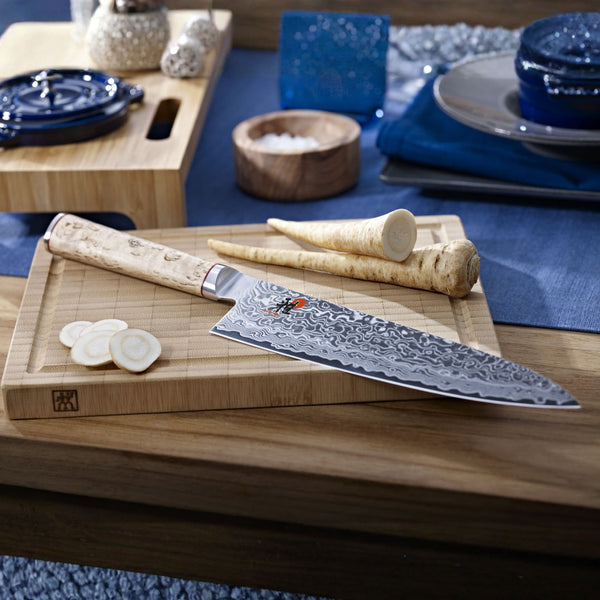
Miyabi 5000MCD Birchwood Gyuto chef's knife, 24cm, with Karelian birch handle
  Explore Miyabi Knives →
5000FCD
5000MCD Birchwood
Core Steel
MC63 / SG2
FC61
Core Steel
Blade Construction
101 layers
49 layers
Blade Construction
Approx. Hardness
63 HRC
60–62 HRC
Approx. Hardness
Handle
Karelian / Masur Birch
Pakkawood
Handle

Which Miyabi Should You Choose?

Choose the 5000FCD if…

  • You want premium Japanese performance.
  • You like Damascus styling.
  • You want excellent cutting performance without going to the highest hardness levels.
  • You want a versatile knife that can become your everyday main chef's knife.

Choose the 5000MCD Birchwood if…

  • You want a higher-end Miyabi experience.
  • Edge retention is a major priority.
  • You appreciate harder powder steels such as SG2.
  • You want a distinctive premium handle and 101-layer Damascus construction.
  • You are prepared to take better care of a harder Japanese blade.

Miyabi Isn't Just About Sharpness

It's easy to reduce Japanese knives to one selling point: sharpness. That's missing the bigger picture.

What makes Miyabi interesting is the way several details work together — the steel, hardness, blade geometry, edge preparation, handle design and craftsmanship.

Sharpness is only the beginning. The real difference is how predictable and controlled the knife feels when you're actually preparing food.

Explore Miyabi at Chef Supply Co

We've brought Miyabi into the Chef Supply Co range for cooks who want more than a generic kitchen knife.

Whether you're looking for a premium everyday Japanese chef's knife or something more specialised, the Miyabi range gives you several levels of steel, construction and design to choose from.

Frequently Asked Questions

Where are Miyabi knives made?

Miyabi knives are handcrafted in Seki, Japan, a city with a long history of Japanese blade making.

Are Miyabi knives actually made in Japan?

Yes. Miyabi's Japanese knife collections are produced in Seki, Japan.

What makes Miyabi knives different?

Miyabi combines Japanese blade-making traditions with modern steel technology, precise blade geometry and detailed finishing.

What is the difference between Miyabi 5000FCD and 5000MCD?

The 5000FCD uses an FC61 core with a 49-layer blade construction and approximately 60–62 HRC hardness. The 5000MCD Birchwood uses an MC63 / SG2 core with a 101-layer blade construction and approximately 63 HRC hardness.

Are Miyabi knives good for beginners?

They can be. The important thing is understanding that a premium Japanese knife needs more care than a basic kitchen knife. If you're prepared to hand wash it, use an appropriate cutting board and maintain the edge properly, there's no reason a beginner can't enjoy one.

Can Miyabi knives go in the dishwasher?

Hand washing is recommended for premium Japanese knives. Dishwashers can expose the blade and handle to harsh conditions that may damage the finish and edge.

Are Miyabi knives worth it?

If you value precision, edge retention, craftsmanship and the experience of using a premium Japanese knife, Miyabi can be worth the investment. If you simply need a knife that does the job with minimal care, you don't need to spend this much.

The best knife isn't necessarily the sharpest one you can buy. It's the one whose design, steel and geometry match the way you actually cook.

And that's where Miyabi becomes interesting.

Shop Miyabi Knives at Chef Supply Co →


Previous
Vegetable Knife: Make Vegetable Preparation Faster, Easier, and More Precise

Leave a Comment

Your email address will not be published.